



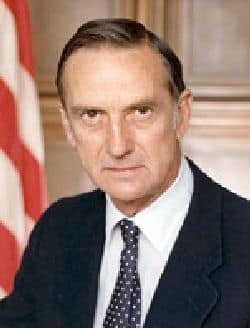
David “Dave” G. Boak, 82, died of abdominal cancer on Sunday, 9 April 2006. He had retired from NSA in 1986 with 42 years of service, highlighted by service as Chief of the NSA Pacific Command Office in Hawaii and Commandant of the National Cryptologic School. To his colleagues, he will always be remembered as “Mr. Comsec,” the authority on communications security, a subject to which he had devoted much of his career with NSA.
He was also an advocate of professional literature for cryptology, and contributed toward that corpus. He was particularly known for his publications, and most prominent among these is his series of lectures on Communications Security, known as the “Boak Papers,” a collected work often compared in its scope and influence with William Friedman’s famous lectures on communications intelligence (COMINT).
Mr. Boak was inducted into the NSA/CSS Cryptologic Hall of Honor in 2010. (see below)
Born in New Rochelle, NY and raised in Summit, NJ, he graduated from the University of North Carolina (Chapel Hill) with a degree in English literature. A later master’s degree in international affairs was awarded by the George Washington University. In government service, he attended the Air War College and the Federal Executive Institute.
During WW II, Mr. Boak served in the Army before transferring to the Office of Strategic Services (OSS), a forerunner of CIA. He was sent to North Africa, supported the French resistance behind German lines, and helped to train Chinese troops in the China-Burma-India theater.
During the late 1950s, he wrote a weekly freshwater fishing column for the Washington Post. He was also an avid and accomplished tennis player, serving briefly as a professional tennis instructor.
NSA/CSS Cryptologic Hall of Honor Entry
David Boak was a communications security (COMSEC) professional who developed new schemes for determining the strength of cryptographic equipment, but he was particularly known for his publications. Most prominent among these is his series of lectures on Communications Security, known as the “Boak Papers,” a collected work often compared in its scope and influence with William Friedman’s famous lectures on communications intelligence (COMINT). A reprint of one of his writings came to the attention of the National Defense University, which incorporated it into current coursework.
Mr. Boak’s basic principles in determining the strength of cryptographic equipment are still used today. His tenets directly and significantly contributed to how prospective secure communications are tested and evaluated. His impact in adding practical security features to existing systems was particularly significant in the Vietnam War and should be considered an important factor in saving American lives in combat. Mr. Boak was also an important figure in developing stringent standards for security in nuclear command and control.
Immediately after World War II, Mr. Boak quickly became an expert on COMSEC, a predecessor to Information Assurance, and proposed core changes to COMSEC doctrine that greatly improved the security of communications equipment.
While serving as commandant of the National Cryptologic School, Mr. Boak presided over the school’s expansion. He improved the scope and quality of instruction by promoting new methods of delivering training that took advantage of emerging technologies.
As an enlisted man in the Office of Strategic Services in World War II, David Boak made two combat parachute jumps: one in France, and one in China. His subsequent work at NSA protected his country and the lives of those engaged in direct combat.
Mr. Boak retired from NSA in 1986 and died in Annapolis on April 9, 2006.